The Complete Guide to Social Proof for SaaS Landing Pages
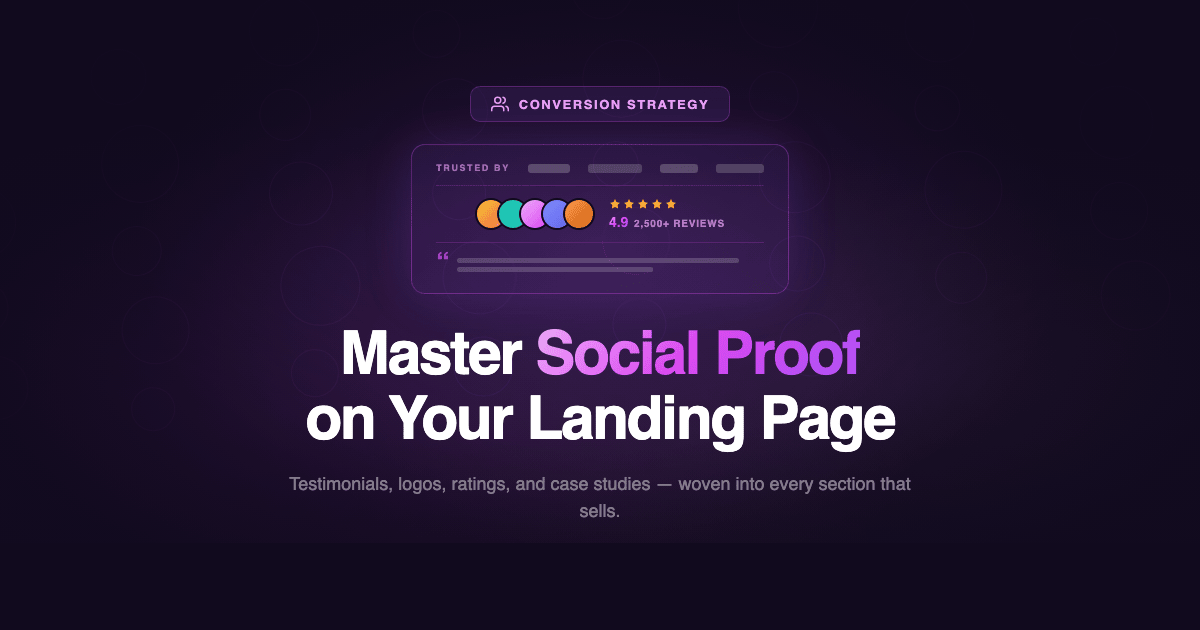
Your landing page says your product is great. Your customers say your product is great. One of these is dramatically more convincing than the other.
83% of consumers trust peer recommendations more than branded content. Testimonials on sales pages can increase conversions by up to 34%. Yet most SaaS landing pages either skip social proof entirely or bury three text quotes in a section nobody scrolls to.
Social proof isn’t a nice-to-have section. It’s a conversion mechanism that should be woven throughout your entire page. Here’s how.
Types of Social Proof for SaaS
1. Customer Testimonials
The most direct form of social proof. A real person describing their experience with your product in their own words.
Text testimonials are easy to collect and quick to scan. Best for volume — show 10-20 on a Wall of Love to create the impression of widespread adoption.
Video testimonials are harder to collect but dramatically more persuasive. 62% of viewers say video increases their trust compared to 34% for text. A customer on camera talking about their results carries authenticity that text can’t match.
Best practice: Use both. Collect text and video through the same form and display them together. A Wall of Love with a mix of video thumbnails and text cards feels rich and authentic.
2. Company Logos
A row of recognizable logos (“Trusted by…”) signals that credible companies use your product. It’s fast social proof — visitors process it in under a second.
Best practice: Show 5-8 logos. Prioritize recognizable brands in your target market. If you serve SaaS companies, show SaaS logos. If you serve agencies, show agency logos. Unknown logos don’t add credibility.
3. Metrics and Numbers
“10,000+ customers” or “500,000 testimonials collected” or “4.9/5 average rating from 200+ reviews.” Numbers create a sense of scale and momentum.
Best practice: Only use real numbers. Inflated metrics erode trust when visitors investigate. A genuine “500 customers” is stronger than a suspicious “10,000+ users.” Pair metrics with a specific context: “500 SaaS companies” is more credible than “500 users.”
4. Star Ratings and Review Scores
An aggregate rating (4.8/5 from 150 reviews) provides at-a-glance credibility. Visitors understand star ratings intuitively — no reading required.
Best practice: Display ratings near pricing or CTAs where visitors are making a decision. A Rating Badge embed showing your aggregate score and review count works well here.
5. Case Studies
Deep-dive stories showing how a specific customer solved a specific problem with your product. Case studies are the heavyweight social proof — they take more effort to create but are the most persuasive for high-stakes buying decisions.
Best practice: Focus on the customer’s problem, the solution process, and the measurable result. “Acme Corp reduced churn by 30% in 90 days” is a case study headline that sells.
6. Social Media Mentions
Screenshots or embeds of tweets, LinkedIn posts, or other social mentions where customers praise your product. These feel organic because they weren’t solicited — someone chose to say something nice publicly.
Best practice: Curate the best mentions and display them alongside formal testimonials. The mix of structured testimonials and spontaneous social posts creates a natural, un-manufactured feel.
Where to Place Social Proof on Your Landing Page
Above the Fold
What: A compact metric or logo strip. “Trusted by 2,000+ SaaS companies” with a row of logos.
Why: First impressions happen in seconds. A credibility signal above the fold tells visitors “this is established and trusted” before they start reading your copy.
Below the Hero Section
What: 1-2 strong video testimonials or a curated text testimonial carousel.
Why: Your hero made a promise. The section immediately below it should prove that promise with a real customer’s words. This is the credibility anchor for the rest of the page.
Alongside Features
What: A relevant testimonial quote or short video next to each major feature.
Why: Features are claims. A customer confirming “this feature saved us 10 hours per week” turns your marketing copy into a verified statement.
Near Pricing
What: A carousel of testimonials focused on value and ROI. Or a Rating Badge showing your aggregate score.
Why: The pricing section is where buying anxiety peaks. Social proof here addresses the “is it worth it?” objection at the exact moment it arises.
Above the Final CTA
What: One powerful testimonial — ideally video — from a customer who describes what they’d tell someone on the fence.
Why: Visitors who’ve scrolled to the bottom are interested but haven’t committed. This is your last chance to convert with social proof before they leave.
Building a Social Proof System (Not a One-Time Section)
Most SaaS companies treat social proof as a checkbox: collect a few testimonials, add them to the landing page, done. This creates three problems:
- Testimonials go stale. A quote from 2 years ago feels dated.
- Volume stays flat. You had 5 testimonials at launch, you still have 5 testimonials a year later.
- No fresh voices. The same 3 customers appear everywhere.
The fix is treating social proof as a continuous system, not a one-time project.
Collection
Build testimonial requests into your product lifecycle:
- 30 days after sign-up — First testimonial request (they’ve had enough time to see value)
- After a support win — Customer just had a great support experience, capture it
- At milestones — Customer processed their 1,000th order, completed their 100th project, etc.
- At renewal — They’re choosing to stay, which means they see value
Use a collection form that lets customers choose text or video. Share it via email, in-app prompts, or after support interactions.
Curation
Not every testimonial belongs on your landing page. Review incoming testimonials weekly:
- Approve testimonials that are specific, results-oriented, or come from your ideal customer profile
- Archive testimonials that are generic (“Great product!”) or off-brand
- Feature your strongest 5-10 testimonials in high-visibility embeds
Display
Spread social proof across your site, not just the landing page:
- Landing page — Wall of Love, Carousel, and Single Testimonial embeds at key decision points
- Pricing page — Rating Badge and testimonials focused on value
- Product pages — Feature-specific testimonials
- Blog posts — Relevant customer quotes as social proof within content
- Email campaigns — Include your best testimonial in onboarding and nurture emails
Refresh
Rotate testimonials every quarter. Add new ones, retire ones that feel dated. Keep the embed content fresh so returning visitors see new faces and new proof.
Social Proof Mistakes to Avoid
Generic quotes without attribution. “Great product! — J.D.” is barely social proof. Full name, role, company, and a photo or video builds real credibility.
All text, no video. If you can collect even 3-5 video testimonials, use them. The authenticity gap between text and video is significant.
Social proof in one spot. Clustering all testimonials in a single section means visitors who don’t scroll that far never see them. Distribute social proof throughout the page.
Fake or exaggerated numbers. “1 million happy users” when you have 500 customers. Visitors are skeptical by default. Inflated numbers trigger that skepticism. Real, modest numbers with context build trust.
Ignoring negative space. A landing page crammed with testimonials everywhere feels desperate. Strategic placement at decision points is more effective than saturation.
Not collecting continuously. Your social proof is only as current as your last collection effort. Build it into your workflows so fresh testimonials keep arriving.
Getting Started
You don’t need to overhaul your entire landing page at once. Start with three placements:
- Logo strip above the fold — Immediate credibility
- 2-3 testimonials below the hero — Proof of your main promise
- Rating badge near pricing — Trust at the decision point
Collect testimonials through a form that supports text and video. Approve the strongest ones. Create embeds for each placement. The whole setup takes under 30 minutes.
Then build collection into your ongoing workflows and keep refreshing your social proof as new testimonials come in.
Start building your social proof engine — free plan, no credit card.